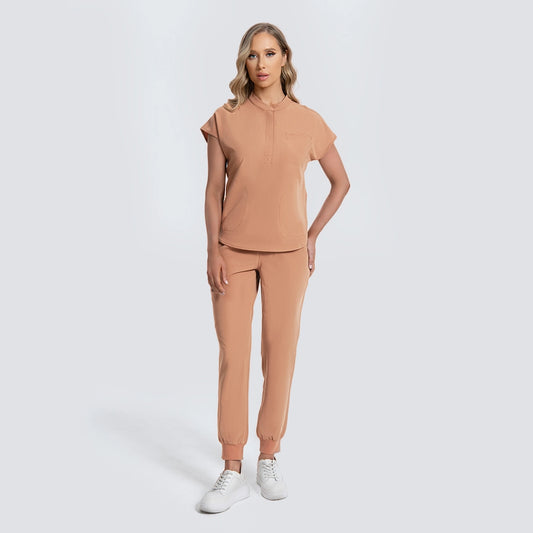



Healthcare workers do not need another miracle claim. They need clothing that fits the job, survives repeated care, and does not create false confidence. That is especially important in 2026, as European infection-prevention programs move toward stronger measurement and accountability while apparel brands promote finishes described as antimicrobial, antibacterial, odor-controlling, or hygienic.
The central question is not simply whether a treated fabric can reduce microorganisms in a laboratory. Many can under specified test conditions. The useful questions are narrower: Which organism was tested? By what method? After how many washes? Does the result apply to odor control, preservation of the textile, or protection of the wearer? Is there evidence of a meaningful clinical benefit? And what practices remain essential even when a treated garment is worn?
The short answer is that antimicrobial scrubs may offer a textile-management benefit, particularly for odor or growth on the material, but they should not be treated as personal protective equipment or as a substitute for hand hygiene, appropriate PPE, environmental cleaning, or a facility’s uniform policy.
1. Why this topic is hot now
In May 2026, the European Centre for Disease Prevention and Control published proposed guidance for establishing and implementing infection-prevention and control programs. The direction is systemic: governance, workforce capability, surveillance, monitoring, feedback, and continuous improvement. ECDC also introduced a digital hand-hygiene monitoring tool. Its message is useful precisely because it puts apparel in proportion. Infection prevention depends on reliable programs and human behavior, not on a single consumer product.
ECDC estimates that more than 3.5 million healthcare-associated infections occur in the EU/EEA each year, with more than 90,000 associated deaths. That burden makes strong apparel claims emotionally attractive. It also makes accuracy essential. A garment can be one managed surface in a larger system; it is not the system.
In the United States, product language is also a compliance issue. The Federal Trade Commission expects textile fiber descriptions and advertising claims to be truthful and substantiated. The agency has specifically warned that rayon derived from bamboo should not simply be labeled “bamboo,” and that sellers need evidence for claims that such material retains the plant’s supposed antimicrobial properties.

2. What “antimicrobial” actually means
Antimicrobial is an umbrella term. A finish might be designed to slow bacterial growth, reduce odor-causing organisms, protect the textile from degradation, or produce a measured reduction in a laboratory sample. Those are different benefits.
Treatments can be incorporated into a manufactured fiber, bound to the surface after weaving, or applied as a finishing chemistry. Their performance can change with abrasion, detergent, oxidizing bleach, temperature, time, and repeated drying. A claim made on a new fabric sample is therefore incomplete unless the expected use life is addressed.
Buyers should distinguish four claim levels:
-
Textile preservation: the treatment is intended to protect the garment itself.
-
Odor management: the treatment may reduce the organisms associated with odor under tested conditions.
-
Microbial reduction on fabric: a named test shows a reduction on the material over a defined time.
-
Clinical protection: evidence shows a lower risk of colonization, transmission, or infection in real care settings.
Movement from one level to the next requires stronger evidence. A result at level three does not automatically establish level four.
3. The evidence ladder
A credible evaluation starts with the test report, not the front-of-package adjective. Ask whether the method was quantitative or qualitative, which organisms were used, the contact time, inoculum, temperature, humidity, control fabric, and wash conditioning. A dramatic percentage can be misleading if it reflects a long contact time that does not resemble a clinical shift.
Next comes wash durability. If a scrub is expected to withstand dozens of cycles, testing only an unworn sample is of limited practical value. The supplier should state the laundering protocol, number of cycles, drying conditions, and whether performance was measured after conditioning.
Then consider real-world contamination. Hospitals are dynamic environments: garments touch chairs, bed rails, devices, bags, and the wearer’s skin. Moisture, organic soil, friction, and repeated contact can differ substantially from a controlled test.
Finally comes the clinical outcome. Does use of the garment reduce transmission or healthcare-associated infection when compared with standard clothing under otherwise similar conditions? This is the hardest evidence to produce. Confounding factors include hand hygiene, staffing, PPE use, cleaning, patient mix, antibiotic exposure, and outbreak status. Without outcome evidence, the responsible conclusion is limited: the textile demonstrated a textile effect under stated conditions.

4. Scrubs, workwear, and PPE are not interchangeable
Ordinary scrubs are workplace clothing. They support identification, modesty, comfort, and practical movement. PPE is selected through a hazard assessment and is designed and certified for a protective purpose. A standard scrub top with an antimicrobial finish should not be assumed to protect against blood, body fluids, aerosols, or hazardous chemicals.
In an operating room, isolation area, laboratory, or other controlled environment, facility-issued garments and laundering rules may apply. A personal scrub set—even a premium treated one—does not override those controls. Product pages should state this clearly. “Wear under required PPE” is a safer and more accurate proposition than “protects you from germs.”
Fluid resistance is also separate from antimicrobial activity. A fabric may resist a small spill yet have no validated microbial treatment; another may show activity in a laboratory but absorb fluid readily. Buyers must evaluate each property independently.
5. The practices that matter every shift
Hand hygiene remains fundamental because hands are active vectors between surfaces, patients, devices, and the worker. A treated sleeve cannot correct a missed hand-cleaning opportunity. Appropriate gloves do not replace hand hygiene either.
Change clothing promptly when visibly soiled or when required by local policy. Do not continue wearing contaminated garments because the label says antimicrobial. Store clean and used garments separately. Follow theatre and restricted-area rules. Use required gowns or aprons for anticipated exposure. Keep personal bags and outerwear out of clean clinical zones where policy requires it.
Laundering should follow the garment label and the employer’s infection-control requirements. A consumer garment may tolerate domestic washing, but some settings require accredited industrial processing, controlled distribution, or on-site changing. The right answer depends on role and setting rather than geography alone.
6. How to evaluate common marketing claims
“Kills 99.9% of bacteria” is not meaningful without the organism, method, time, starting concentration, and laundering state. It also does not tell the buyer whether the effect changes transmission.
“Naturally antibacterial bamboo” deserves particular caution. Much soft apparel marketed with bamboo imagery is rayon or viscose made from bamboo-derived cellulose. The finished manufactured fiber should be described accurately, and any antimicrobial claim needs evidence on that finished textile.
“Permanent” should trigger a request for the defined useful life and care conditions. No garment is permanent in the ordinary sense: fabric wears, seams fail, fit changes, and care chemistry matters.
“Hospital grade” has persuasive force but may not identify a recognized garment standard. Ask which standard, jurisdiction, product category, and test report support the phrase.

7. Choosing by clinical setting
For general wards and outpatient clinics, prioritize fit, cleanability, durability, pocket safety, and compliance with dress policy. An antimicrobial feature can be considered after those basics.
For emergency and critical care, mobility, rapid changing, fluid-exposure planning, and compatibility with PPE usually matter more than a finish. Facilities may prefer controlled inventory or laundering.
For operating rooms and procedural areas, use facility-issued attire where mandated. Personal scrubs should not cross restricted-zone rules.
For dentistry, veterinary work, laboratories, and imaging, examine the actual hazards: splash, chemicals, animal contact, heat, magnetic safety, or equipment snagging. The ideal garment may require fluid management, minimal metal, or specific sleeve and pocket construction rather than antimicrobial chemistry.
8. A buyer’s evidence checklist
Before paying a premium, request the exact fiber composition, treatment name or functional description, target organisms, test method, independent report where available, result after repeated laundering, permitted care chemistry, skin-safety information, and the precise scope of the claim. Confirm whether the benefit protects the textile, manages odor, or is intended to protect people.
Also evaluate the garment without the treatment: Does it fit through a full range of motion? Are seams secure? Is the fabric comfortable under required PPE? Does it dry quickly? Are pockets positioned safely? Can the color and size be reordered? A weak scrub does not become good clinical workwear because it has an impressive finish.
Conclusion
Antimicrobial scrubs can be a legitimate product category, but the strongest purchase decision is an evidence-literate one. Look for defined tests, washed performance, careful language, and compatibility with local policy. Treat antimicrobial technology as a possible supplementary textile feature—not as infection control in a garment.
FAQ
Are antimicrobial scrubs PPE?
Usually not. Unless the specific product is certified for a defined hazard and use, ordinary scrubs remain workwear.
Can antimicrobial scrubs prevent healthcare-associated infections?
Laboratory activity on fabric does not by itself demonstrate fewer infections. Clinical outcome evidence would be required.
Do they eliminate the need to change visibly soiled clothing?
No. Follow local policy and change promptly after visible soil or relevant exposure.
Does the treatment survive washing?
It depends on the chemistry and care method. Ask for results after a stated number of representative wash cycles.
Are “bamboo scrubs” naturally antimicrobial?
Do not assume so. Confirm the legally correct fiber name and request evidence for the finished fabric.
Are antimicrobial scrubs worth the premium?
They may be if the defined benefit matters to the wearer and is supported after realistic laundering. Fit, durability, and policy compliance should come first.
Sources
-
ECDC, “From guidance to action: ECDC advances Infection Prevention and Control on World Hand Hygiene Day,” May 5, 2026: https://www.ecdc.europa.eu/en/news-events/world-hand-hygiene-day-2026
-
European Society of Clinical Microbiology and Infectious Diseases position statement, “Integrating planetary health into infection prevention and control in healthcare settings,” 2026: https://www.sciencedirect.com/science/article/pii/S1198743X26002053
-
US Federal Trade Commission, “Clothing and Textiles”: https://www.ftc.gov/business-guidance/industry/clothing-and-textiles
-
US Federal Trade Commission, “How to Avoid Bamboozling Your Customers”: https://www.ftc.gov/business-guidance/resources/how-avoid-bamboozling-your-customers