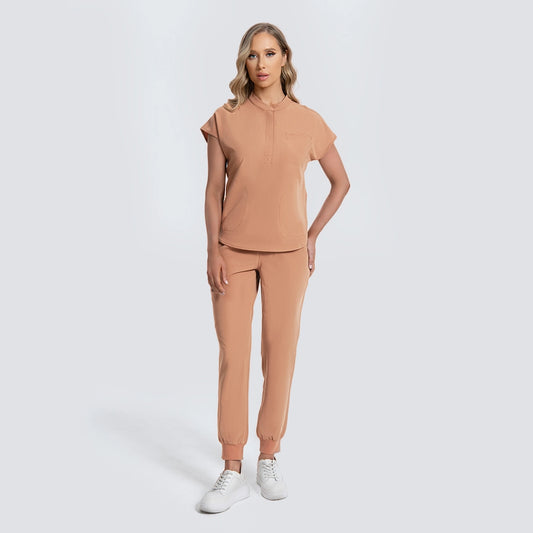



Scrubs get worn, washed, and worn again. They are part of everyday life for nurses, doctors, dental professionals, and many other healthcare workers. So when two scrub sets look similar but carry very different price tags, it is natural to wonder: is the more expensive option actually worth it?
The answer depends on what you get for your money.
Quality scrubs can offer a more comfortable fit, thoughtful details, and construction that suits repeated use. But a higher price alone does not guarantee any of those benefits. The best scrubs are the ones that meet your workplace requirements, fit your body, and remain practical throughout your working day.
Here is how to recognize quality, decide which features deserve your budget, and choose scrubs you will want to wear again.
What Makes a Pair of Scrubs High Quality?
Quality is the result of several features working together: fabric, fit, stitching, functional design, and suitable care requirements.
A scrub top can feel wonderfully soft but still be impractical if the neckline gaps when you bend forward. Trousers can have plenty of pockets but become uncomfortable once those pockets are filled. A stylish set can look excellent on arrival yet be a poor choice if its care instructions are incompatible with your workplace’s laundry process.
Instead of judging quality by a brand name or a single feature, ask a few practical questions:
-
Can I move comfortably in these scrubs?
-
Does the fabric provide appropriate coverage?
-
Are the seams, pockets, and waistband neatly constructed?
-
Can the garments be cleaned according to workplace requirements?
-
Am I paying for features I will actually use?
These questions help separate useful improvements from details that simply make a product sound impressive.
1. Comfort Matters Beyond the First Few Minutes
A quick fitting-room try-on tells you how scrubs feel while standing still. It tells you much less about how they will feel after repeated walking, reaching, bending, and sitting.
Small discomforts become more noticeable with time. A rough seam may rub against your skin. A tight shoulder area may pull whenever you reach forward. A waistband that initially feels secure may press uncomfortably when you sit down.
Well-chosen scrubs should allow everyday movement without constant adjustment. You should not need to keep pulling down your top, straightening twisted seams, or repositioning your trousers.
Pay attention to the parts of the garment that stay in close contact with your body: the neckline, underarm seams, waistband, and labels. Their finish can matter as much as the overall softness of the fabric.
Comfort is also personal. Some people prefer a light, relaxed feel, while others like a more structured fabric. The right choice is the one that feels suitable for your body and working environment.
2. Fabric Quality Is About Balance
Fabric descriptions can be confusing. Stretch, softness, breathability, easy care, and wrinkle resistance all sound desirable, but no single claim tells the whole story.
Fiber content offers useful information, yet it does not fully describe how a finished garment will perform. Fabric weight, construction, finishing, and garment design also affect the experience of wearing it.
Start with your working conditions. If you spend much of the day moving through warm spaces, consider how the fabric feels during activity. If your workplace is cool and permits an undershirt, make sure the scrubs remain comfortable with that extra layer.
Coverage matters too. Lightweight fabric should still provide the coverage you need when sitting, bending, or stretching. Check lighter colors in good lighting rather than relying entirely on product photos.
When evaluating stretch, think beyond how far the fabric can extend. Notice how the garment sits after normal movement. Does the waistband stay comfortable? Do the knees look excessively stretched out? Does the top return to a natural shape?
You do not need to pull aggressively on the material. A normal try-on with realistic movements is a better starting point.
3. A Better Fit Can Be More Valuable Than Extra Features
One of the most worthwhile reasons to spend more on scrubs is access to a fit that works better for your proportions.
A standard size may fit your waist but feel tight around your thighs. A top may fit your shoulders but be too long through the body. Buying a larger size can sometimes create new problems rather than solve the original one.
Useful sizing options may include separate top and trouser sizes, different inseam lengths, or alternative cuts. These choices can make a meaningful difference if standard sets rarely fit you well.
Before ordering, check whether the size chart describes body measurements or garment measurements. Do not assume your size will be identical across brands or collections.
During a try-on, reach forward, raise your arms, sit down, and bend comfortably. Look for pulling across the back, gaping at the neckline, pressure at the waist, or restriction through the hips and knees.
If you normally wear a permitted base layer, include it in your fitting. Try the trousers with your usual work shoes as well, so you can judge their length accurately.
The goal is enough room for movement with a secure, manageable fit.
4. Construction Details Deserve a Closer Look
Product photography often highlights color and silhouette. Construction quality becomes easier to assess when you look at the areas that experience regular movement and handling.
Inspect the pocket openings, side seams, waistband, and trouser seams. Look for obvious skipped stitches, open seams, loose threads, or fabric puckering.
A tidy appearance is useful, but avoid assuming that more stitching automatically means better construction. The stitching needs to suit the fabric and the part of the garment.
Check that drawstrings adjust smoothly and that the waistband feels stable during ordinary movement. If there are fasteners, make sure they work properly and do not create uncomfortable pressure.
These details cannot tell you exactly how long a garment will last. They can, however, help you identify obvious problems before you start wearing it regularly.
Clear returns policies and responsive customer service are also worth considering, particularly when ordering a style you have never tried before.
5. Functional Pockets Should Match Your Routine
More pockets do not always mean more useful scrubs.
A pocket can be too shallow, difficult to reach, or positioned where its contents pull awkwardly on the garment. Several poorly placed pockets may be less useful than a smaller number that work well.
Think about the items you are permitted to carry and how you normally access them. Consider whether the pocket openings are convenient, whether contents remain stable during movement, and whether carrying your usual items changes the fit.
Always follow workplace rules for storing tools, sharp items, and sensitive information. A pocket’s capacity does not determine what is appropriate to put inside it.
Other practical details deserve the same approach. Side vents, top length, neckline depth, and trouser cuffs should support your routine. A feature is worth paying for when it solves a problem you actually encounter.
6. Long-Term Value Goes Beyond the Purchase Price
A lower price can be attractive, especially when you need several sets. But the initial cost is only one part of the value calculation.
A simple way to compare purchases is to consider cost per wear:
Cost per wear = purchase price ÷ number of useful wears
For example, imagine one scrub set costs $30 and provides 30 useful wears. Its purchase cost works out to $1 per wear. Another costs $60 and provides 100 useful wears, making its purchase cost $0.60 per wear.
These are hypothetical examples, not predictions of how long any product will last. Their purpose is to show why the cheapest item is not always the most economical choice over time.
The reverse is also true. An expensive set that fits poorly and stays in your wardrobe offers little value.
Consider alteration costs, care requirements, and any recurring problems that make a garment inconvenient to use. A reasonably priced set that fits correctly and suits your routine may be a better purchase than a premium option with features you do not need.
7. Laundry Compatibility Is Essential
Scrubs need to fit your workplace’s cleaning requirements as well as your body.
Before buying, find out whether your employer supplies uniforms, handles laundering, or specifies particular fabrics, colors, and care processes. If you purchase your own scrubs, compare those requirements with the garment’s care label.
Avoid guessing about wash temperatures, cleaning products, or drying methods. If the manufacturer’s instructions are unclear, ask for clarification before ordering.
Garments contaminated with blood or other potentially infectious materials should be handled through the appropriate workplace process. Ordinary home laundry habits should not replace the procedures required for those situations.
Similarly, do not reduce required cleaning or changing simply to protect the color or extend the life of a garment.
A useful scrub set is one that supports the necessary care routine. If it requires a process that is incompatible with your workplace, its other features may not justify the purchase.
8. Understand What Performance Claims Actually Mean
Terms such as “antimicrobial,” “fluid-resistant,” and “advanced fabric technology” can make a product sound appealing. Their usefulness depends on what the manufacturer can explain about them.
Look for specific information about the claimed property, its intended use, and any care limitations. Avoid interpreting a broad marketing term as a guarantee of clinical protection.
Everyday scrubs should not be assumed to replace required protective clothing. A water-repellent finish, for example, does not by itself establish that a garment is suitable for a particular exposure risk.
For ordinary buying decisions, focus first on fit, coverage, construction, and care compatibility. Treat additional performance claims as features to evaluate carefully, rather than reasons to overlook those basics.
9. A Professional Appearance Should Remain Practical
Well-fitting scrubs in good condition can help you maintain a tidy workplace appearance. Appropriate colors, manageable garment lengths, and a comfortable silhouette all contribute.
However, professional ability is not measured by the price of a uniform. You do not need the most expensive brand to look appropriately dressed or take pride in your work.
Choose a style that meets workplace expectations and feels natural to wear. If you like a particular color or cut, consider whether you will still enjoy wearing it regularly after the novelty fades.
The most satisfying purchase is often the set that quietly becomes part of your routine because it works well.
How to Choose Quality Scrubs on a Budget
You can make a thoughtful purchase without immediately choosing a premium collection.
Start by identifying what needs improvement in your current scrubs. Perhaps the trousers are too long, the shoulders feel restrictive, or the pockets are inconvenient. A specific problem gives you a clearer reason to choose a different product.
Set a budget and prioritize:
-
Workplace compliance and suitable care requirements.
-
Comfortable fit and sufficient coverage.
-
Sound construction.
-
Useful pocket placement.
-
Personal preferences such as color and styling.
If you are trying a new brand, consider buying one set first. Assess it through normal wear and approved laundering before ordering several more.
This is especially useful if you are starting a new role, rotating between departments, or expecting uniform requirements to change.
Frequently Asked Questions
Why buy quality scrubs if they are going to get dirty anyway?
Because getting dirty does not make comfort, fit, and construction less important. Regularly used workwear should suit both your working day and the necessary cleaning routine. Quality is about how well the garment supports those demands.
Are expensive scrubs always better?
No. Price can reflect branding, design, distribution, and other factors. Compare the features you need and the garment’s actual suitability rather than treating price as a quality score.
Should scrubs fit loosely or closely?
They should provide comfortable movement without excessive restriction or unnecessary loose fabric. The right balance depends on your body, the garment’s cut, and workplace requirements. A movement-based try-on is more useful than judging fit while standing still.
How can I judge durability before buying?
Inspect the construction, read the care instructions, and look for detailed information about use and washing. Reviews that describe specific conditions can be helpful, but no general claim can guarantee lifespan. Your own experience with one set is valuable before making a larger purchase.
How many scrub sets should I own?
Choose a quantity that supports your schedule, required changing practices, and approved laundry arrangements. There is no universal number. Start with those practical needs rather than buying extra sets simply because they are discounted.
Choose the Quality You Will Notice Every Day
Quality scrubs are worth considering when they deliver benefits you can use: comfortable movement, a dependable fit, practical storage, and compatibility with your required care routine.
Before paying more, ask what the additional cost will improve. Will the correct inseam eliminate an awkward fit? Will a different cut give you more comfortable movement? Will a better-positioned pocket make an everyday task easier?
When you can answer those questions clearly, you are better equipped to choose scrubs that justify their price—and earn a regular place in your working wardrobe.