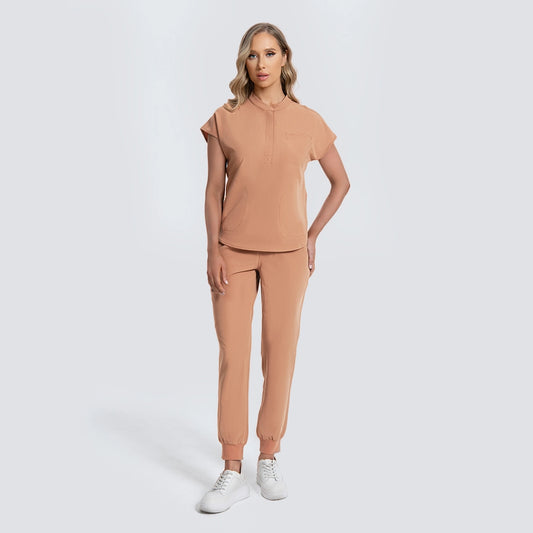



A fitting-room mirror can only tell you so much about a set of scrubs. They may look crisp when you first put them on, then feel stuffy after you have been moving around. They may fit well when you stand still, yet pull across your shoulders when you bend. Fabric that feels soft straight out of the package may lose its shape after a few washes. Choosing scrubs means looking beyond color and style to the fabric itself.
Even then, product descriptions such as “high stretch,” “soft against the skin,” and “quick drying” can be hard to interpret. Does more cotton always mean more comfort? Is a higher spandex percentage worth paying for? Will fabric that feels cool to the touch stay comfortable through an entire shift? A single number on a label cannot answer these questions.
This guide connects fabric labels with everyday wear and care. You do not need to be a textile expert. Knowing what to check, what to ask, and how to assess the fit can help you find scrubs that suit your needs.
1. Start With Your Needs: What Should the Fabric Improve?
Before shopping, think about what bothered you most about your last set of scrubs. Did your back feel damp during busy periods? Did the knees feel tight when you crouched? Were they difficult to care for, or did loaded pockets pull the garment down? Identifying two or three priorities makes it easier to narrow your choices.
Try expressing your needs in one sentence: “I move around a lot, so I need freedom of movement and scrubs that look neat after washing.” Or: “My workplace is cold, so I want a comfortable feel and enough room for a base layer.” Clear priorities make marketing language less distracting.
Also check your workplace requirements for colors, styles, changing, and laundering. If your employer launders uniforms, the garment must be compatible with that process. Consider preferences such as softness and stretch within these practical limits.
Think about your budget over the life of the garment. Two equally priced sets can offer very different value if one needs frequent ironing or changes size after washing, while the other is easy to maintain and rotate into daily use. Include the time spent on care, not just the price tag.
2. Read the Label: Different Fibers Serve Different Purposes
Cotton: Consider Both the Feel and What Happens After You Sweat
Many people like cotton because its feel is familiar. Its moisture-absorbing properties make it common in clothing worn against the skin. However, absorbing moisture and drying quickly are different things. Along with the initial feel, consider how much you sweat, how readily you can change into fresh scrubs, and your drying arrangements.
Do not treat “100% cotton” as a guarantee of comfort. A thick, tightly woven cotton fabric can feel very different from a lightweight, loosely constructed one. Shrinkage and wrinkling also depend on garment processing and care. The right cotton scrubs should balance a pleasant feel with manageable upkeep.
Polyester: Look Beyond the Word “Synthetic”
When considering polyester, shoppers often focus on shape retention, drying, and ease of care. But polyester fabrics are not all alike. Differences in yarn, construction, and finishing can make one garment feel light and another noticeably heavy, even when both labels list the same fiber.
If you are concerned about feeling hot or stuffy, do not stop at the polyester percentage. Check fabric thickness, available breathability or moisture-wicking information, and how the finished garment feels on your body. Construction and finishing can change moisture transport. Both “polyester is always stuffy” and “polyester always dries quickly” are oversimplifications.
Spandex: Check the Recovery as Well as the Stretch
Spandex adds elasticity and may also appear on labels as elastane. LYCRA® is a brand of elastic fiber, rather than a generic name for all spandex.
For scrubs containing spandex, the percentage is only a starting point. The direction of stretch and the fabric’s ability to recover after movement are more relevant to daily use. If the material has to stay stretched tight just for you to move, the size or cut may be wrong. Stretch should support movement, not justify buying a smaller size.
Viscose and Other Regenerated Cellulosic Fibers: Check the Specific Fiber and Care Instructions
Some scrubs contain viscose, a type of rayon. These fibers are made by processing cellulose from plant sources, but they should not be treated as equivalent to cotton.
When choosing these blends, assess the drape, feel against the skin, and behavior when damp. Check whether the garment supports your usual washing, spin, and drying routines. A plant-based origin does not automatically mean greater durability, easier care, or suitability for every workplace.
3. Compare Blends Without Looking for a Universal “Perfect Ratio”
Blending combines the characteristics of different fibers. Labels may list cotton and polyester, blends with elastic fibers, or combinations containing regenerated cellulosic fibers. However, a fiber-content label is not a complete performance report. It cannot tell you exactly how warm the garment will feel or whether it will pill after washing.
For example, two sets with identical fiber percentages can feel different if one uses thicker fabric and a close fit, while the other is lighter and offers more room across the shoulders. A popular blend is not necessarily the right choice for your body or work routine.
Compare garments in three stages. First, read the composition. Next, check construction, thickness, and care requirements against your working conditions. Finally, confirm your choice through wear and washing. For an unfamiliar collection, buying one set or requesting a sample is often more useful than ordering several at once.

4. Pay Attention to Construction: The Same Fibers Can Perform Differently
Fabric depends on both the fibers used and how the yarns are assembled. You do not need to memorize technical terms, but it helps to notice surface texture, thickness, stretch direction, and feel. Detailed product information makes it easier to connect these observations with your needs.
Plain weaves have a straightforward interlacing structure, twills often show diagonal lines, and knits are formed from loops. These describe construction, not quality rankings. A diagonal pattern does not automatically guarantee abrasion resistance, and a knitted fabric is not necessarily cool or prone to losing its shape.
Fabric weight describes mass per unit area, but a lower number is not always better. A lighter material may feel less burdensome, yet still needs adequate coverage and stability during wear. With heavier fabrics, consider whether they feel too warm. For light colors in particular, check opacity under both daylight and indoor lighting while sitting and bending.
Assess the fabric together with the garment design. Shoulder room, back construction, crotch shaping, and waistband design all affect mobility. Comparing how far two fabric swatches stretch cannot fully predict the comfort of two finished sets of scrubs.
5. Breathability, Absorbency, Wicking, and Quick Drying: What Do They Mean?
These terms often appear together, but they describe different properties. Breathability can refer broadly to air and moisture-vapor movement; when comparing airflow, look specifically for air-permeability information. Absorbency concerns taking up moisture. Wicking describes how liquid moves and spreads through fabric. Drying speed concerns how long moisture takes to leave it. These properties can interact, but they are not interchangeable.
A fabric may absorb water readily yet stay damp against the skin. Another may absorb relatively little into the fibers but use yarn structure or finishing to help liquid spread. Processing can change moisture-management performance even when the underlying fiber remains the same.
Turn marketing terms into practical questions: “Under what conditions was drying speed tested?” “Is specific test information available?” “Are there laundering limits on this performance?” Without supporting information, treat the description as something to assess rather than a promise of all-day comfort.
A water-drop check at home may reveal local wetting or spreading, but it cannot replace standardized testing or establish the breathability or protective performance of a whole garment. Temperature, humidity, sweat levels, and additional clothing layers also affect the experience.
6. Wrinkle Resistance and Wash Durability: Judge Convenience After Laundering
Wrinkle resistance does not mean a garment will never crease, and wash durability cannot be judged by how new fabric feels. For frequently laundered workwear, fit retention, smooth seams, and changes in the fabric surface matter more than softness at unboxing.
When your scrubs arrive, inspect sizing and workmanship without affecting their condition or return eligibility. Once you decide to keep them, wash them according to the label. Record key measurements, such as top length, inseam, and waist width, then measure the same way after drying instead of relying on memory to assess shrinkage.
Follow the finished garment’s care label rather than choosing a fixed washing temperature based only on fiber content. Detergent, bleach, tumble-drying temperatures, and ironing settings may be limited by the fabric, dyes, and trims. If your workplace uses a centralized laundry service, confirm compatibility before buying.
Notice details that are easy to miss: curled pocket edges, waistband recovery, uneven fading, or bagging at the knees. A few before-and-after photographs can help you decide whether to purchase more of the same style.
7. Choose for Your Workday Rather Than Chasing Every Feature
If you walk and bend frequently, prioritize freedom of movement. Your shoulders, hips, thighs, and knees need sufficient room. Stretch can help, but fit remains the foundation. Load the pockets with your usual items, then walk and sit again to check whether the garment shifts or pulls downward.
If you sweat easily, consider weight, skin feel, and moisture management together. Avoid ruling out an entire fiber category or relying only on a cool initial touch. That first sensation does not predict how the garment will feel later. Try one set and assess it in your actual working environment.
If your workplace is cold, allow for comfortable layering. Simply choosing thicker fabric may leave you feeling burdened during busy periods. Where your dress code permits, consider suitable base layers or outer layers, and repeat your movement checks while wearing them.
If you wash frequently or buy for a team, check care compatibility first. Team purchases also require an appropriate size range, feedback from different body types, and convenient replenishment. Have staff with different builds and roles try samples before using their shared feedback to guide the final choice.
8. Do More Than Stand in Front of a Mirror: Try These Five Movements
First, reach both arms forward and raise them to around shoulder height. Check for pulling across the shoulders or back and noticeable neckline movement. Second, bend slowly and check lower-back coverage, the neckline opening, and waistband position. Stay within a comfortable range rather than pushing the movement.
Third, sit naturally and notice sustained pressure around the abdomen, hips, or thighs. Fourth, perform a comfortable shallow squat, checking for pulling at the crotch, knees, and waist. Fifth, put your everyday items in the pockets and walk around. Notice twisting, rubbing, or any restriction in your stride.
Afterward, check whether the garment returns to its natural shape. Persistent tension may call for a different size or cut, while excessive bunching may indicate an unsuitable length or shape. A “high-stretch” label cannot resolve a fundamentally poor fit.

9. Ask What Performance Claims Actually Mean
For a “water-repellent” claim, check which liquids and conditions it covers and how the garment must be maintained. For an “antimicrobial” claim, look for the organisms tested, the method used, and the scope of the result. Do not infer benefits that the product does not explicitly establish.
Performance finishes on everyday scrubs do not automatically make them equivalent to specific protective equipment. Follow your workplace requirements for protection. Fabric-selection guidance should help you understand clothing properties without turning them into unsupported protective claims.
Absolute statements such as “permanent,” “complete,” or “suitable for every environment” deserve a closer look. A clearly defined benefit with stated conditions is more useful than a string of unverifiable adjectives.
10. Run Through This Checklist Before Buying
Before ordering, confirm the full fiber composition, size guide, and garment measurements. Check for information about thickness, stretch direction, and care. Review the basis for performance claims, the return policy, and your workplace dress requirements. After delivery, complete the movement checks and decide to keep the garment before washing it.
When comparing several options, record the same observations for each: feel while standing, comfort during movement, pocket loading, measurements after washing, and drying and finishing effort. Notes in your own words will often reveal more than a star rating with no defined standard.
The right scrubs do not necessarily have the highest cotton content, the greatest stretch, or the longest list of features. They should support your movements, remain in acceptable condition through regular care, and be something you are happy to wear often. Understanding the label is the starting point; evaluating the garment through real wear and laundering is what helps you find the right fabric.