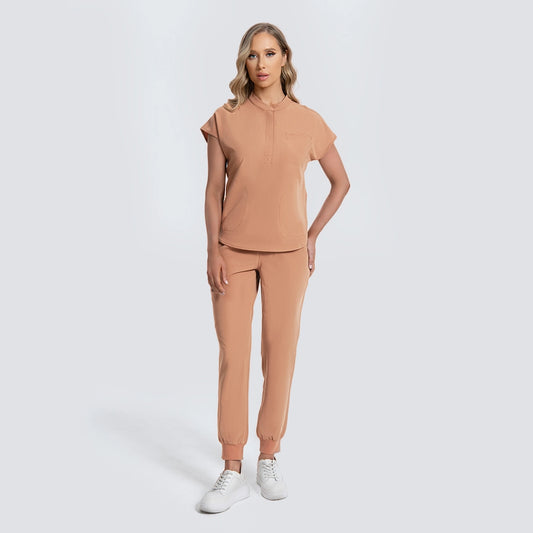



In 2026, performance fabrics are transforming healthcare apparel. Clinicians are moving away from traditional cotton scrubs toward advanced TRS (Terylene, Rayon, Spandex) blends engineered for the demands of modern medical environments. Here's why the shift is happening—and why it matters for your career.
Introduction: From Disposable Uniforms to High-Performance Equipment
For decades, the medical community accepted a subpar standard: boxy, stiff, and moisture-retaining cotton scrubs treated as disposable commodities. But as we move through 2026, the global healthcare landscape has shifted.
The modern clinician—the surgeon, the ER nurse, the specialist—is now recognized as a "tactical athlete." A 12-hour shift is no less demanding than an ultra-marathon. Apparel worn 60+ hours a week must be more than just clothing; it must be high-performance equipment.
Chapter 1: The Molecular Engineering of TRS Fabric
In 2026, the gold standard of medical textiles is TRS: Terylene, Rayon, and Spandex. This is not a simple blend—it is a meticulously engineered tri-blend designed to solve the inherent failures of organic cotton.
- Terylene (Advanced Polyester): Provides structural integrity that resists the harsh alkaline environment of medical-grade laundering, maintaining a crisp, professional silhouette for years.
- Rayon (Cellulose Silk): Derived from regenerative cellulose, it mimics the drape and coolness of silk, providing the breathability clinicians crave.
-
Spandex (4-Way Stretch): True mobility requires expansion in all directions. Our 2026 technical weaves eliminate the restrictive "pull" during high-intensity procedures.

Chapter 2: Thermal Regulation and Capillary Science
One of the most significant advancements is the integration of Non-Circular Fiber Cross-Sections. Traditional cotton fibers are round and hollow, trapping moisture and causing the dreaded "damp scrub" sensation.
Modern technical fibers are engineered with 'X' or 'Y' shaped cross-sections, creating microscopic channels that use capillary action to pull sweat away from the skin instantly. This Moisture-Wicking Technology ensures that even in a high-pressure ER, the clinician stays dry and thermoregulated.
Chapter 3: Antimicrobial 2.0 and the Fluid-Barrier Shield
Post-2024, demand for "intelligent" safety features has peaked. The 2026 technical scrub serves as a proactive defense mechanism.
- Silver-Ion Integration: Antimicrobial agents are embedded at the polymer level before the yarn is spun. These ions work 24/7 to rupture the cell walls of odor-causing bacteria.
-
DWR (Durable Water Repellent): Using eco-friendly C0-DWR treatments, the fabric surface tension is modified so that blood, saline, and other bodily fluids bead up and roll off rather than soaking into the fibers.

Chapter 4: The Ergonomics of Clinical Authority
The "boxy" look of the past is over. Today, design is driven by Anatomical Seaming, influenced by the global Athleisure movement.
- Articulated Knees: Preventing the "baggy knee" look while allowing full range of motion.
- Gusseted Crotches: Reducing seam stress during long periods of walking.
-
The Power Silhouette: A tapered, tailored fit that communicates authority. In a world where patients judge professional competence within seconds, your visual presentation matters.

Chapter 5: Sustainability and the Circular Economy
The technical revolution is also a sustainable one. Performance polyesters in 2026 are frequently sourced from Recycled PET (Post-Consumer Plastics). Furthermore, the extreme durability of technical fabrics contributes to "Slow Fashion"—one high-quality TRS set can outlast three traditional cotton sets.
Conclusion: Investing in Your Professional Longevity
Choosing your scrubs is not a trivial fashion choice; it is a career investment. The transition to technical workwear in 2026 represents a commitment to personal performance, patient safety, and professional dignity.
The era of the "disposable uniform" is over. The era of the Technical Professional has arrived.
Frequently Asked Questions (FAQ)
Do technical scrubs require special laundering?
No. Wash in cold to warm water and tumble dry on low. Avoid fabric softeners, as they can coat the moisture-wicking channels.
Is the antimicrobial treatment safe for sensitive skin?
Yes. Modern silver-ion technology is "locked" into the fiber, meaning it stays on the fabric to fight bacteria without leaching onto your skin.
Why are technical scrubs more expensive?
You are paying for the ROI. They offer superior durability, color-fastness, and comfort that far out-performs multiple sets of cheap cotton scrubs.
References & Sources
- Global Medical Apparel Market Analysis: 2026 Forecast.
- Comparative Analysis of TRS vs. Cotton. Journal of Medical Medical Materials.
- WearFIGS Q1 2026 Performance & Trend Report.
- Silver-Ion Efficacy in Clinical Blends. International Journal of Infection Control.
- The Psychology of Professional Appearance. European Healthcare Review (2026).