

A healthcare professional’s workday may begin with a clinical shift and include team meetings, training sessions, or external events. Scrubs are familiar everyday workwear, but are they appropriate for all these settings?
Scrubs can look polished and professional. Whether they meet a business casual dress code, however, depends on the occasion and your workplace’s requirements.
Are Scrubs Considered Business Casual?
Generally, scrubs are clinical uniforms rather than traditional business casual clothing. Business casual typically includes well-fitting trousers, shirts, sweaters, and simple dresses or skirts.
Some healthcare facilities allow employees to wear scrubs to internal meetings or training sessions. This makes scrubs appropriate for those occasions, but it does not mean they can replace business casual clothing in every setting.
When deciding what to wear, consider your schedule first, then check the requirements provided by your employer or event organizer.
Clinical Shifts: Put Workplace Requirements First
For clinical shifts, follow your workplace’s requirements for uniform colors, identification, footwear, and department-specific clothing. Within those guidelines, choose clean, well-fitting garments that accommodate your everyday movements.
After getting dressed, check a few practical details:
- Your neckline stays secure when you bend.
- Your shoulders and back can move freely when you reach.
- Your waistband remains comfortable when you sit.
- Your pant hems stay off the floor when you walk.
- Your pockets hold everyday essentials without noticeably pulling your clothing down.
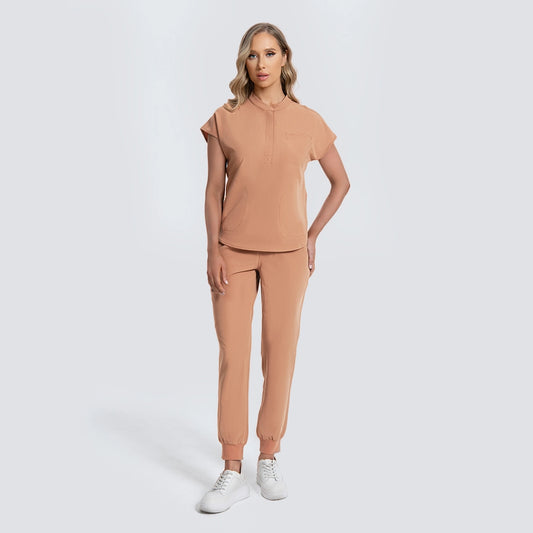
A professional clinical appearance does not require complicated styling. A clean, coordinated scrub set and appropriate footwear can create a polished look.
If your role requires designated uniforms or access to restricted areas, follow the relevant changing and laundering procedures.
Meetings: Consider the Purpose of the Event
The type of meeting helps determine whether scrubs are appropriate.
For unit huddles, handover discussions, or brief team meetings during a shift, approved clinical uniforms are often suitable. Internal training sessions may also allow scrubs, especially when participants need to return to clinical duties afterward.
Administrative meetings, external events, formal presentations, and activities outside your scheduled shift may have different expectations. If the invitation specifies business casual, choose office clothing that meets that requirement.
Well-fitting trousers with a shirt, or a simple blouse with a cardigan, are practical options. Add a blazer when a more formal appearance is expected.
If a meeting follows clinical work, confirm whether you need to change and allow enough time to do so.
Job Interviews: Follow the Recruiter’s Guidance
A healthcare role may require scrubs for everyday work, but the interview may follow a different dress code. Unless the recruiter specifically requests scrubs, business casual or business professional clothing is usually a suitable starting point.
Common options include:
- Well-fitting trousers with a neatly pressed shirt.
- A blouse paired with a skirt or trousers.
- A simple, coordinated suit.
Choose clean, comfortable footwear suitable for walking. Some interviews include a facility tour, so practical shoes can help you move comfortably throughout the visit.
If the interview includes a skills assessment, practical activities, or clinical shadowing, confirm whether scrubs are required, whether changing facilities are available, and whether you should bring a separate outfit.
Prepare just as carefully for a video interview. Check the lighting, camera framing, and how your clothing appears on screen so the conversation can stay focused on your experience and abilities.
Can Dark-Colored Scrubs Replace Business Casual Clothing?
Navy, black, and charcoal scrubs can create a clean, understated appearance. Color alone, however, does not determine whether clothing is appropriate for an occasion.
Similarly, tucking in a scrub top or adding a blazer does not automatically make the outfit business casual.
If your workplace permits scrubs for nonclinical activities, style them within those guidelines. If an event specifically requires business casual clothing, prepare an outfit that meets that expectation.
What to Wear for Different Occasions
| Occasion | Suggested Attire |
|---|---|
| Regular clinical shift | Approved scrubs and footwear that meet workplace requirements |
| Unit huddle during a shift | Clinical uniforms in line with department guidelines |
| Internal training | Check the event instructions to confirm whether scrubs are permitted |
| Administrative meeting or external event | Business casual or professional clothing, as requested |
| Standard job interview | Business casual or business professional clothing, following the recruiter’s guidance |
| Skills assessment or clinical shadowing | Confirm whether scrubs and a change of clothes are required |
Appropriate workwear should support your role and suit the occasion. Keeping suitable scrubs ready for clinical shifts, alongside a separate outfit for meetings or interviews, can make getting dressed for work more straightforward.