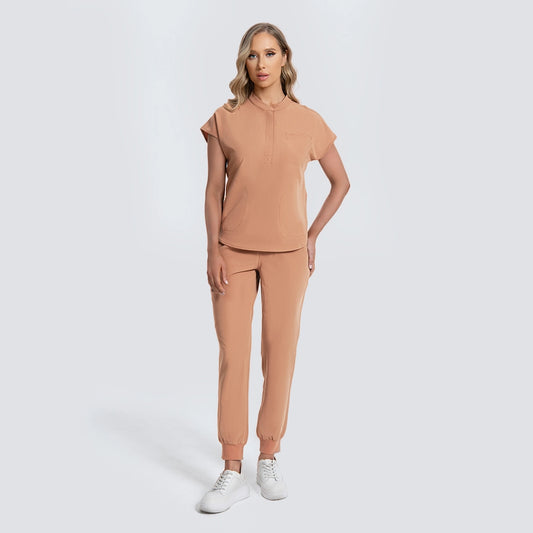


Personalized scrubs can make an everyday uniform feel more considered. A neatly embroidered name adds an individual touch, while a clinic logo helps bring a team’s appearance together. On a white lab coat, a small embroidered detail can complete a clean, professional look.
Getting the result right takes more than choosing a font. The garment, wording, placement, thread color, and artwork all influence how the finished embroidery looks and feels.
Whether you are ordering your first personalized scrub top, choosing a gift, or coordinating uniforms for a practice, this guide explains the decisions worth making before production begins.
What Should You Embroider on Medical Uniforms?
The most useful embroidery usually communicates a small amount of information clearly. Common choices include:
- A name
- An approved professional title or credential
- A clinic or practice logo
- A department or team name, where permitted
You do not need to include everything. A name and one relevant professional designation may be enough for an individual uniform. For a team, an organization logo may provide the consistency you need without adding personal details to every garment.
Before choosing the wording, check your workplace’s dress code. Some employers specify approved logos, naming formats, garment colors, and embroidery locations. Students should also confirm their program’s requirements before personalizing uniforms for clinical placements.
Embroidery can complement your uniform, but it does not replace a required identification badge or an introduction to a patient.
1. Choose the Right Scrubs or Lab Coat First
Before thinking about thread colors, make sure the garment works for you.
An embroidered detail cannot improve an uncomfortable neckline, restrictive shoulders, or an unsuitable fit. Start with a style that meets your workplace requirements and feels comfortable during the movements you perform throughout the day.
When checking a scrub top, try reaching forward, raising your arms, sitting, and bending. Wear your usual permitted base layer and place a few everyday essentials in the pockets. Look for pulling across the chest, restricted movement, or a neckline that shifts more than you would like.
For a lab coat, check the fit over your normal workwear. The shoulders and sleeves should allow comfortable movement, and the front should sit naturally when worn as intended.
Use the size chart for the specific product rather than relying only on your usual clothing size. If you are unfamiliar with a style, consider trying an undecorated garment before committing to personalization.
Why Garment Style Matters
Different garments provide different areas for embroidery.
A V-neck scrub top may have a chest pocket, shaping seams, or a badge loop that limits placement. A stand-collar top may offer a different layout. On a lab coat, the lapels and front opening can affect visibility.
The design should suit the actual garment. A placement that looks balanced on one style may need adjustment on another, particularly across a wide range of sizes.
2. Keep Names and Credentials Clear
Name embroidery works best when the wording is accurate and easy to read.
Submit your text exactly as you want it to appear, including capitalization, punctuation, accents, and line breaks. Do not assume that an email signature or billing name will automatically be used for the embroidery.
For example, a simple two-line layout might read:
Alex Morgan
RN
This is a fictional design example. Your own wording should reflect the name and professional designation you are authorized to use.
Decide Which Information Matters Most
Your name will often be the main line, with an approved role or credential below it. A clear hierarchy helps the design remain readable without requiring a large embroidered area.
Avoid adding every qualification simply because space appears to be available. Long strings of credentials can make the lettering smaller and the overall layout harder to read.
If you are unsure about the correct title, abbreviation, or order of credentials, confirm it with your employer or relevant professional organization before submitting the design.
Think About Long-Term Use
Names, roles, departments, and employers can change while a garment is still wearable.
Consider which information you want permanently attached to your uniform. A simple name may remain useful across different workplaces, while an employer logo or department name may have a narrower use.
Privacy preferences matter, too. Some workplaces have specific requirements about displaying surnames. Confirm the policy before deciding between a first name, full name, or another approved format.
3. Choose Embroidery Placement Around the Garment
There is no universal embroidery position that works for every scrub top or lab coat. The best location depends on the garment’s construction and any workplace requirements.
Always describe placement from the wearer’s perspective. “Wearer’s left chest” is clearer than “left side,” which can be interpreted differently when looking at a front-facing photograph.
Above the Chest Pocket
The area above a chest pocket can work well for a short name or compact design when enough space is available.
Check the distance from the neckline, pocket edge, and nearby seams. The embroidery should look balanced without crowding those features.
Also confirm that the production method will preserve the pocket’s opening and usable space. Depending on how embroidery is applied to an assembled garment, stitching could affect pocket function.
On the Opposite Chest
The side opposite a pocket may offer a less interrupted area for a name or logo.
For lab coats, check where the lapel falls naturally. A design that looks visible on a flat garment might become partly covered when the coat is worn.
Think about accessories as well. Badge reels, stethoscopes, and outer layers may obscure an otherwise suitable location.
Combining a Name and Logo
A name and logo can be placed on opposite sides or arranged together, depending on the available space.
Keep their visual weight balanced. A large logo beside very small lettering can make the name difficult to notice, while several equally prominent elements may make the chest area feel crowded.
Review the complete arrangement on the chosen garment before approving it.

4. Select a Font and Thread Color That Stay Readable
An attractive design on a screen does not always translate into clear embroidery.
Lettering needs to work at its finished physical size. Fine strokes, elaborate flourishes, and tightly spaced letters can become difficult to distinguish when stitched into a small area.
For names and professional wording, a clean, straightforward font is a practical starting point. If you prefer a decorative script, ask whether it will remain legible at the proposed size.
Check the Actual Dimensions
Ask for the planned width and height rather than judging size from a zoomed-in image.
A long name may need a different layout from a short one. Instead of shrinking everything automatically, consider an approved shorter display name, another font, or a revised line arrangement.
The goal is a design that looks proportionate to the garment and remains easy to read.
Consider Contrast
Thread color should work with the garment color.
Light thread can provide clear contrast on navy or other dark scrubs, while darker thread may stand out on a white lab coat. More subtle combinations can suit a decorative logo, but may be less effective when quick name recognition is the priority.
For teams wearing several scrub colors, review each garment-and-thread combination. A shade that works beautifully on one background may be difficult to see on another.
Screen colors are only a reference. If close brand matching matters, ask about available thread colors and whether physical samples can be reviewed.
5. Prepare Your Logo for Embroidery
A logo designed for a website or printed brochure may need adjustments before it can be embroidered.
Thread has thickness, and fabric is flexible. Tiny lettering, narrow gaps, delicate outlines, and complex gradients may not reproduce clearly at chest-logo size.
A simpler approved version of your logo can often communicate the same identity more effectively.
For example, a clinic’s full branding might include a symbol, business name, tagline, and website address. For embroidery, the symbol and business name may be sufficient.
Provide Clear Original Artwork
Send the best original file you have and ask which formats are accepted.
A clear vector file can help with reviewing shapes and proportions, but it is not automatically a machine-ready embroidery file. Avoid relying on a screenshot when a better source file is available.
If you already have an embroidery file, have it assessed for the intended garment and size. A design prepared for a large patch or thick jacket may need different treatment on a scrub top.
Understand Digitizing
Digitizing converts artwork into instructions that embroidery equipment can follow. It involves decisions about stitch types, direction, density, and sequence.
Ask whether any setup or digitizing charge applies and what is included. For future reorders, clarify how the approved design will be referenced and whether it can be reused.
Use Authorized Logos
Only submit a logo you own or have permission to reproduce.
Employees and students should check before ordering garments with a hospital, school, or placement organization’s branding. If the artwork needs simplifying, obtain approval from the person responsible for that identity before production.
6. Consider Fabric, Comfort, and Care
Embroidery should feel comfortable as well as look professional.
A densely stitched design can create a firmer area within a flexible garment. For that reason, a compact design may be more suitable than a large, heavily filled graphic on some scrub fabrics.
The reverse side matters, too. Backing or finishing materials may sit close to the skin, so assess comfort during normal movement whenever a sample is available.
Review the Finished Combination
Check for visible puckering, distortion, rough edges, or uncomfortable stiffness.
If you are planning a larger order, ask about sample options before production. A physical sample can reveal details that a digital preview cannot, including texture, fabric movement, and the feel of the backing.
Follow Compatible Care Instructions
Use the care guidance applicable to both the garment and its embroidery, together with your workplace’s laundering requirements.
Do not assume that decoration makes a garment suitable for higher temperatures, stronger chemicals, or an industrial laundry process. Confirm compatibility before ordering if your workplace requires a specific cleaning method.
Embroidery is a personalization detail. It does not make the garment protective equipment or change its intended use.
7. Review the Design Before Production
A careful approval process helps prevent avoidable mistakes.
Where a preview or confirmation is provided, check more than the overall appearance. Review:
- Exact spelling and punctuation
- Credentials and job titles
- Font and line breaks
- Garment style, color, and size
- Embroidery location
- Design dimensions
- Thread colors
- Logo version
Read the text separately before evaluating the layout. It is easy to overlook a small spelling mistake when focusing on an attractive design.
For team orders, check every person’s details. Approving one example does not confirm that longer names or different credentials will fit equally well.
Keep the final approved information together so there is a clear reference for the order.
8. Make Team Orders Easier to Manage
A coordinated team uniform does not require everyone to wear exactly the same silhouette.
You can create consistency through approved garment colors, a shared logo, and a standard naming format while allowing suitable fit choices for different team members.
Start with the organization’s uniform requirements, then confirm available styles and sizes.
Use One Order Coordinator
Choose one person to collect information and communicate final instructions.
A single, organized order list reduces the risk of conflicting messages, missed changes, or duplicated requests. Each wearer can still confirm their own details before the list is finalized.
Record the garment style, color, size, quantity, embroidery wording, and relevant design instructions for each person. If tops and pants require different sizes, list them separately.
Plan for Future Reorders
Keep a record of the approved artwork and garment specifications.
Ask how new employee orders and replacements will be handled. Consider whether spare garments should carry only the organization logo, allowing individual names to be added later if appropriate.
Remember that similar color names across different products do not guarantee identical shades. If close coordination is essential, review the actual garments before committing to a larger order.

9. Check Pricing, Timing, and Customization Terms
Before placing an order, understand what the quote includes.
Depending on the project, pricing may involve the garment, embroidery location, design preparation, individual names, or other requested details. Ask for clarification so you can compare the complete cost.
For time-sensitive orders, provide the date you need to receive the garments. Artwork review, production, dispatch, and shipping are separate parts of the overall schedule. Confirm the timing for your specific project rather than assuming a standard garment’s delivery estimate applies.
Confirm Details Before Personalization
Personalized items require particular attention to sizing and spelling because they are made to the approved specifications.
Kungfu Scrubs lists embroidered items as final sale and unavailable for standard returns or exchanges. Confirm your size and customization details before placing an order, and review the current return policy.
If an item arrives damaged or differs from the confirmed order, contact customer service with your order details and clear photographs so the issue can be reviewed.
Frequently Asked Questions
Can Every Scrub Top Be Embroidered?
Suitability depends on the garment, fabric, construction, and proposed design. Confirm the exact product and embroidery request before ordering.
Should I Put My Name or My Clinic Logo on My Uniform?
Start with your workplace’s requirements. A name provides an individual detail, while a clinic logo supports a coordinated team appearance. Some uniforms can accommodate both.
How Many Lines of Text Should I Choose?
Use only the lines needed to communicate the approved information clearly. A name and credential may work in two lines, but the final layout should suit the wording and garment.
Can Embroidery Affect a Pocket?
It can, depending on placement and production method. Confirm that the proposed design will preserve pocket access and function.
Can I Order Personalized Scrubs as a Gift?
Yes, but confirm the recipient’s size, preferred name, current professional designation, and workplace requirements first. If those details are uncertain, let the recipient choose the personalization.
Can Embroidery Be Removed Later?
Removal may leave visible needle marks, holes, or changes in the fabric. Do not assume a name or logo can be removed without affecting the garment.
Does an Embroidered Name Replace an ID Badge?
No. Continue to wear the identification required by your workplace.
Personalize Your Uniform With Kungfu Scrubs
Well-chosen embroidery can add a distinctive detail to a uniform you already enjoy wearing. The strongest designs are usually clear, proportionate, and suited to the garment: a carefully placed name, an accurate professional designation, or a logo prepared for stitching.
Explore Kungfu Scrubs medical uniforms and lab coats, then review our custom embroidery service.
For clinic and team orders, visit our wholesale program. Contact us at service@kungfuscrubs.com with your preferred garments, quantities, and embroidery requirements to confirm available options and project details before ordering.